
Why self-love is often problematic
It must be superseded by "the purification of the self".


A piece of unsolicited advice that you hear more frequently than you would like to, a buzzword that finds its way to luring advertisements designed to coax people into consuming more, and an indispensable principle that many self-development gurus invest in to convince their audience of its power, self-love has been exploited and misapplied in many different ways.
I think we associate the concept of self-love with our value, hence we falsely equate the lack of it with self-hatred. This very topic has been viewed for so long through a polarizing lens: the presence of self-love means the absence of self-hatred, and vice versa. To keep confusion at bay, it is essential to note that genuine self-love is crucial for maintaining our mental stability. But an extreme version of it can backfire on us as it encourages us to love ourselves despite our mistakes and sins. Sometimes self-love doesn’t heal as much as it kills the spirit of a warrior inside you, the spirit that motivates you to improve yourself and learn from your failures.
The world is obsessed with the toxic version of self-love as a response to the staggering number of people who let their insecurities and vulnerabilities define who they are. Many people regard self-love as the best solution for their lack of confidence. But, unfortunately, they don’t distinguish between toxic self-love and healthy self-love. The former fools you into glossing over life-changing improvements that must be embodied in your life, while the latter pushes you to identify your shortcomings and address them.
Rarely do we discuss the dangers of unconditional self-love that leads to consumerism, individualism, and, in some severe cases, discrimination. We don’t bring up the possibility of weaponizing it to give credence to racist ideologies and cover certain patterns of aggressive behavior. We omit to mention how self-love could be transformed into the malicious infection of selfishness, which takes a long time to be treated.
For the most part, we misuse self-love as we find it an effective alternative cure for our psychological issues: we are told that minor afflictions like imposter syndrome, fear of the future and change, or social shyness can be easily overcome by the magical sentence ‘love yourself’. While it is important to appreciate and respect yourself, self-love must not be the backup plan used in place of self-accountability. We are ordained to hold ourselves accountable and never heed the whims of alnaf alamara, not to love ourselves obsessively under the pretext of eliminating the shadow of self-flagellation.
This is a weak excuse, for the antithesis of hating the self is not being infatuated with it. If self-love does not function as a soft force to galvanize us into renovating the inner building of our Nafs and make it spiritually vibrant, it becomes an invisible malignant tumor that metastasizes inside the soul. It is soul that cries out for genuine transformations.
There is a crucial, yet overlooked, point when promoting self-love: The advice does not work for everyone.
Those whose hearts are stripped of humanity and mercy cannot simply be advised to love themselves, for they hold a pact with devils who accompany them on their evil journey. If you know someone's sins and misconduct, you have to show them how to find the right path and make up for their troubled past. Telling them to love themselves is counterproductive, as it encourages unconditional self-acceptance and removes any sense of guilt over their past mistakes.
Thus, their chance of changing themselves is fairly low as they assume that their moral bankruptcy and spiritual poverty are not just acceptable but also justifiable. They do a disservice to themselves and to their community because their toxic self-love will soon morph into arrogance and ignorance. If this just happens on an individual level, imagine what society would be like if everyone loved themselves blindly.
The very concept of self-love loses its value and meaning when it is abused to perpetuate the worst version of yourself. Think of it as if you fall in love with someone cruel or rude, and the person does not have the pressure or impetus to better themselves because they think that you love them as they are. This is exactly what occurs inside the brains of those who integrate self-love into their lives and turn a blind eye to their blunders.
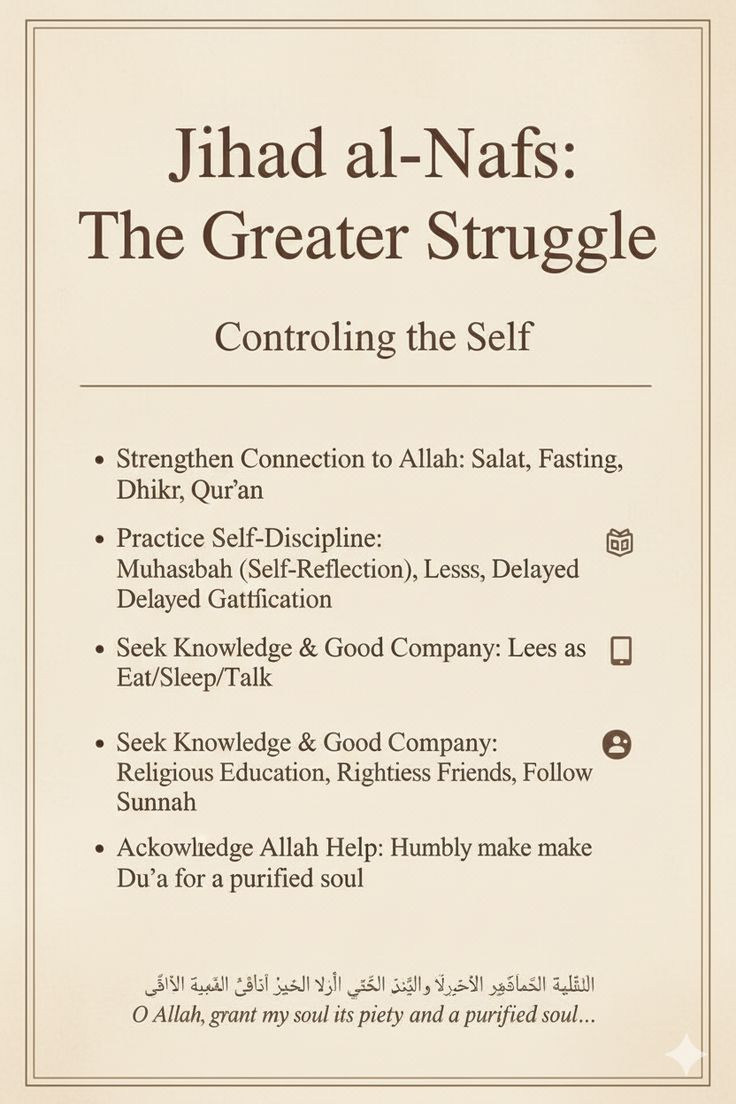
This intentional blindness leads to following one's whims and obeying the self ( al Nafs), which is the most dangerous spiritual malady that both the holy Qur’an and the Prophetic Sunna warn against. In order to recover from this malady, we need to replace blind self-love with a new concept: Tazkiyat al-Nafs, or the purification of the soul.
It can be defined as a lifelong process of cleansing the nafs ( ego/ lower self) from negative traits like greed, ignorance, arrogance, dishonesty, and jealousy, and replacing them with virtues like patience, humility, sincerity, and submission to God.
Purifying the soul helps one cultivate inner peace and closeness to Allah. And the latter point is the ultimate goal of our existence and the most important reason for gaining Baraka in our lives. Tazkiyat al-Nafs involves reflection, following divine guidance, aiming to transform the self from being capricious and needy to becoming peaceful and content, and striving against one’s own desires ( Mujahadah Nafs).
Here comes the quintessential part of the whole process: Mujahadah Nafs. It is the Islamic spiritual struggle that means striving or fighting against one's lower self and its evil inclinations in order to align actions with faith and attain spiritual purity.
Our beloved Prophet considered it the “ greater jihad” because it is a hard battle to win. The self that we are advised to love blindly is the same one that we are supposed to resist its temptations and whims.
The paradigm is clear: we are moving from loving ourselves obsessively to purifying it and then striving against its whims and caprices. This is not an easy journey as it requires patience, self-discipline, and strong faith.
Ibn al-Qayyim says: "Your nafs is just like your enemy, once it finds you serious, it obeys you. If it finds weakness in you, it will take you as a prisoner”.
In short, it is all about your intention and your ability to make a serious decision to improve yourself and resist internal lures. The first step is to have a sincere intention to change yourself.
The biggest changes don't begin from the outside, but from within.
If you don’t convince yourself that change is inescapable, no one will. And if you fall prey to toxic self-love, you are less likely to make yourself uncomfortable and challenge yourself.
However, as long as you put in an active, ongoing effort to purify yourself, you will overcome the temptations of your Nafs. The next step is commitment: we strive to achieve what we set our minds to.
Insofar as your intention and commitment are aligned, you are ready to embark on the real work: translate these two components into actions.
Perform the five prayers on time, do charity, support the weak, and obey the divine commands. Be aware of your old behavioral patterns and consider whether they still serve you.
Watch yourself to ensure adherence to God's path and keep track of your daily acts so as to evaluate your performance. At the end of every day, repent for the previous mistakes and ask Allah Almighty for guidance.
Nothing can be more dangerous than loving yourself to the point of complacency, where you are satisfied with yourself and with your whims. Self-love, if cultivated arbitrarily, is likely to morph into a new religion that compels you to believe in it.
Our Creator never commands us to be infatuated with ourselves and allow vanity to creep into our hearts, but to fix our interiority and be resilient. Being obsessed with yourself means that you are blind to your sins and flaws. And this is exactly what we are witnessing in our current times. You find some sinners exude confidence and boast about normalizing wrongdoing in the name of practicing self-love.
You may come across emotionally immature adults who take the shortest path and accept themselves as they are, embracing self-love unconditionally. The more frequently you tuck your vices under the layers of your ego, the harder it becomes to attend to your mistakes, and the less likely you are to repent.
Loving something insanely doesn't entail recognizing the dark side of its character, acknowledging its vulnerabilities, or evaluating its performance objectively. This propels one not only to worship oneself but also to deify it. This is the extreme stage where yourself becomes your God, and you obey it thoughtlessly.
Allah SWT warned against this group of people, the worshippers of the self , in the holy Quran.
He said: “Have you seen he who has taken as his god his [own] desire, and Allah has sent him astray due to knowledge and has set a seal upon his hearing and his heart and put over his vision a veil? So who will guide him after Allah? Then will you not be reminded?” ( Surah Al-Jaathiyah: 23).
If you do yourself a favour and leave the imaginary bubble to which you are chronically confined, you can see how the mind becomes the primary reference on which some rely to navigate their lives. This phenomenon persists despite the flawed nature of the mind— it is filled with biases and false beliefs. It is nigh impossible to make a fair judgment or gauge the validity of an action as long as we resort to our different minds, each of which has a unique perception of reality. Here comes the indispensability of the ultimate godsent guidance, the holy Quran, that transcends human reason and defies human fallibility.
Although the opposite of it is intolerable, the implications of blind self-love are dangerous, especially if it is misused and overused. We need advice that encourages us to be disciplined and to hold ourselves accountable, not the one that deceives us into ignoring our sins and flaws.
We want to be guided to the right path, not to lose our moral compass in favour of the modern definition of freedom.
In place of the cliche ‘ love yourself’, we should promote the concept of purifying the self, challenge it, and resist its lusts until it becomes peaceful and spiritually awake.
You must compete with yourself, improve it, fix it, and train it to bear pressure and responsibility. You are not supposed to fall in love with yourself, for the lover is oblivious to the negativities of the beloved.
{قَدْ أَفْلَحَ مَنْ زَكَّاهَا * وَقَدْ خَابَ مَنْ دَسَّاهَا}
"Successful is he who purifies it (the soul), and failing is he who corrupts it”
(91:9-10)
With love, Marwa
thank you for sharing this. jazakillahu kairan
That was wonderful.
Thank you for the reminder 🥹